

Xenohormesis: The Science of Using Plant Stress to Activate Cellular Defense in Skin

Quick answer
Growing regulatory pressures, such as the EUDR, are challenging traditional botanical supply chains, making consistent quality and verifiable provenance increasingly difficult for formulators. Simultaneously, demand for evidence-backed bioactives that confer adaptive physiological benefits continues to rise. This article outlines the scientific basis of xenohormesis and its implications for sourcing high-potency ingredients.
Key Takeaways
Xenohormesis leverages plant stress compounds to activate human cellular defenses.
Controlled abiotic stress in vertical farms upregulates target metabolites.
This offers potent, consistent bioactives for cosmetic and nutraceutical applications.
Such ingredients align with market demand for longevity-focused skincare.
Definition and Origins of Xenohormesis
Xenohormesis describes the phenomenon where stress metabolites produced by plants, often under environmental duress, confer adaptive benefits to heterotrophic organisms that consume them. The concept, coined by Howitz and Sinclair in 2004, bridges interspecies communication through biochemical signals. This interkingdom signaling suggests an evolutionarily conserved mechanism for adaptive stress responses across species.
Historical Context
The term "xenohormesis" was first introduced in 2004, offering a framework to understand how phytochemicals from stressed plants might activate longevity pathways in consuming organisms. This theory posits that plants, unable to flee adverse conditions, adapt by producing a suite of protective compounds. Many traditional plant-derived medicines originate from these stress-induced compounds, as noted in Harvard Magazine coverage from 2005. The foundational idea draws parallels between plant and animal stress responses, particularly involving sirtuins.
The Role of Stress in Plant Biochemistry
Plants, when exposed to abiotic stressors such as UV radiation, drought, specific elicitors, or wounding, activate defense mechanisms. Crucially, these mechanisms involve the upregulation of secondary metabolites. These compounds, while vital for plant survival, also serve as signaling molecules when ingested.
Key stress factors inducing metabolite production include:
UV-B radiation exposure
Controlled water deficit (drought)
Mechanical wounding or pruning
Salinity stress
Mechanisms: Plant Stress Metabolites and Cellular Pathways
Plant stress metabolites initiate xenohormetic effects by engaging conserved cellular pathways in consuming organisms. These include activation of sirtuins, AMPK, and the Nrf2 pathway, which are central to adaptive stress responses and cellular protection.
Targeted Cellular Pathways
Many phytochemicals act as mild stressors that trigger protective responses rather than direct antioxidant scavenging. This adaptive response is primarily mediated through pathways like Nrf2. The Nrf2 pathway, for instance, upregulates genes encoding antioxidant enzymes and detoxification proteins, providing broader and longer-lasting protection than direct antioxidant molecules. Research from Hooper et al. in 2010 highlighted potential leverage points for drug discovery.
Key Xenohormetic Compounds
Specific plant compounds demonstrate potent xenohormetic activity:
Resveratrol: Found in grapes and berries, known for sirtuin activation.
Quercetin: A flavonoid active in diverse cellular stress responses.
Fisetin: Present in strawberries, also linked to sirtuin activation.
Epigallocatechin gallate (EGCG): A catechin from green tea, activating AMPK.
Curcumin: From turmeric, active in inflammatory and oxidative stress pathways.
Sulfur-containing phytochemicals also contribute to stress signaling, as discussed in Biotechnology Frontiers (2025).
How do stress-induced metabolites impact human cells?
Plant stress metabolites, when absorbed by human cells, function as low-dose stressors that prime the cell's endogenous defense systems. This process, often referred to as hormesis, enhances cellular resilience against subsequent, more severe stressors. This activation of adaptive stress responses is a core principle behind the efficacy of many functional ingredients; for a deeper dive into these compounds, explore what are secondary metabolites in plants.
Evolutionary and Ecological Context
The xenohormesis theory is grounded in evolutionary biology, proposing an ancient communication system between plants and animals. Plants developed complex biochemical defense systems to survive environmental threats, producing compounds that inadvertently signal adaptive responses in organisms consuming them.
Survival Mechanisms in Plants
Plants lack mobility, necessitating sophisticated biochemical responses to threats. Exposure to pathogens, herbivores, or environmental extremes like UV radiation or drought triggers the synthesis of secondary metabolites. These compounds serve functions such as defense, signaling, and protection against oxidative damage.
Interspecies Communication
The consumption of these stress-induced plant compounds by heterotrophs translates plant "alarm signals" into adaptive responses. This mechanism is thought to provide a fitness advantage, preparing the consumer for potential environmental challenges. The implication is that a "stressed" plant offers more than just nutrition; it provides cellular resilience. To understand the deliberate induction of these plant defense mechanisms, consider biotic stress examples plants can experience.
Applications in Medicine, Nutrition, and Agriculture
Xenohormesis has broad implications across various industries, from pharmaceutical development to nutritional supplements and novel agricultural practices. The ability to enhance bioactive compound production offers significant commercial opportunities.
Medical and Nutraceutical Applications
The application of xenohormetic principles is particularly relevant in the development of nutraceuticals and pharmaceuticals. By delivering concentrated stress metabolites, these products aim to activate intrinsic protective pathways in the human body. This approach underpins ingredients targeting longevity, cellular repair, and anti-inflammatory responses.
Hormetic Skincare and Cosmeceuticals
The skincare market is increasingly seeking ingredients that go beyond simple hydration to offer active cellular benefits. Hormetic skincare leverages plant-derived compounds to induce mild stress responses in skin cells, enhancing their natural repair and defense mechanisms. This can lead to improved resilience against environmental aggressors. Ingredients can be positioned for adaptive cellular signaling rather than just static antioxidant benefits.
Potential benefits in skincare include:
Enhanced cellular repair and detoxification
Increased skin resilience to environmental stressors
Modulation of inflammatory pathways
Support for collagen and elastin production via cellular signaling
Enhanced Agricultural Production
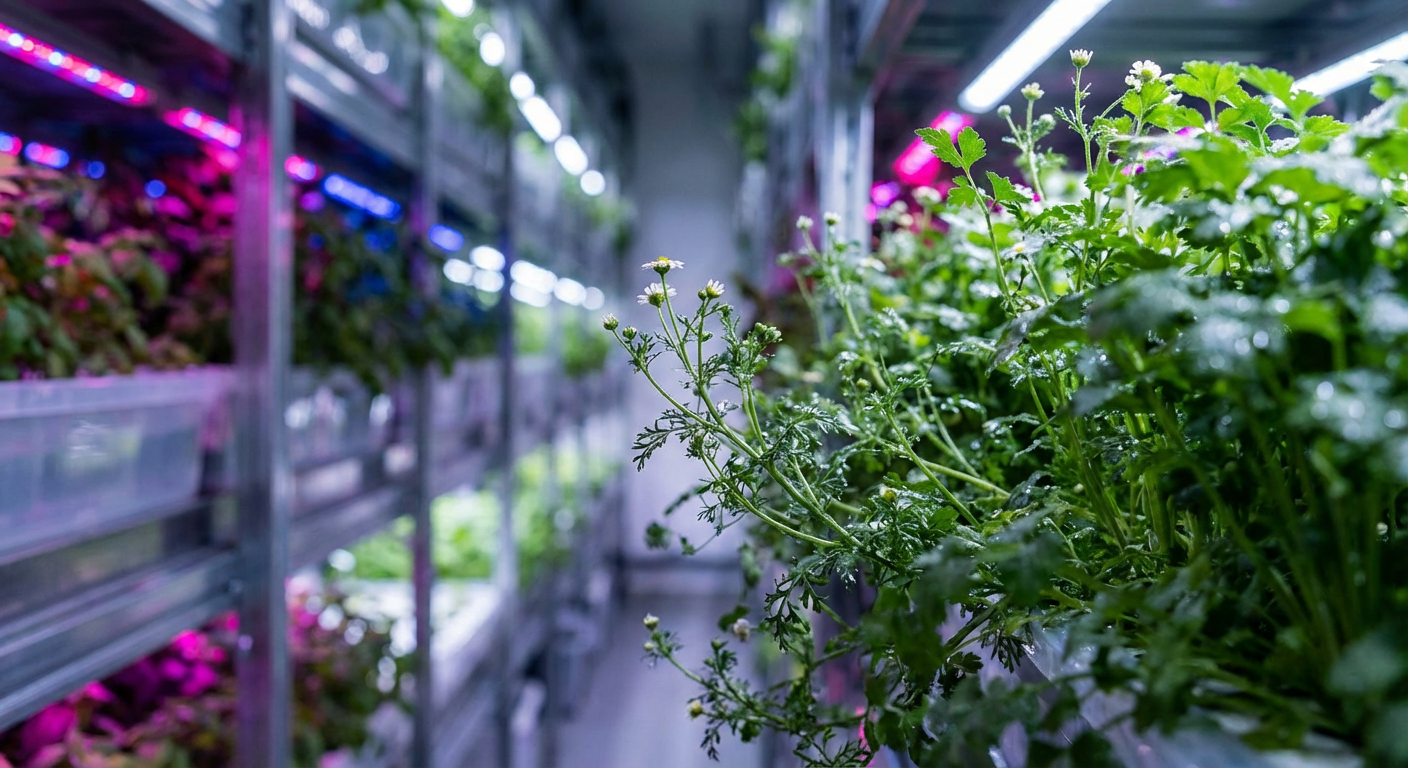
Controlled abiotic stress application in agriculture, especially in controlled environment agriculture like vertical farms, can significantly boost the concentration of desirable secondary metabolites. This optimization directly addresses market demands for higher potency and consistency. Cisneros-Zevallos (2020) highlighted this approach in horticulture.
Strategies for increasing xenohormetic metabolites:
Precise UV-B light spectrum and intensity management
Controlled irrigation cycles mimicking drought
Application of elicitors like Methyl jasmonate (MeJA)
Optimized nutrient delivery schedules (e.g., salinity stress)
“The relevance of xenohormesis depends not just on compound activity, but on consistent production. Controlled environments transform stress from a variable into a defined input, enabling reliable and standardized ingredients.”
Shirin Moradi, Senior plant scientist, Supernormal greens
Xenohormesis Within the Hormesis Framework
Xenohormesis is a specific type of hormesis, referring to the beneficial effects of low-dose exposure to stressors. It distinguishes itself by involving stressors produced by one species (plants) that benefit another (consumers).
General Principles of Hormesis
Hormesis describes a dose-response relationship characterized by a beneficial effect at low doses and an inhibitory or toxic effect at high doses. This biphasic response is observed across various biological systems and involves adaptive repair or overcompensation mechanisms.
Examples of hormetic agents:
Exercise (mild physical stress leading to strength gains)
Caloric restriction (mild metabolic stress extending lifespan)
Certain toxins (low doses stimulating detoxification pathways)
Radiation (low doses potentially activating repair mechanisms)
Distinction from Direct Antioxidants
Traditional antioxidants directly neutralize reactive oxygen species (ROS). Xenohormetic compounds, however, typically work by activating endogenous antioxidant enzymes and repair pathways, offering a more systemic and sustained protective response. This is a crucial distinction for formulators seeking deeper cellular efficacy.
Characteristic | Direct Antioxidants | Xenohormetic Agents |
|---|---|---|
Mechanism | Direct ROS scavenging | Activates endogenous cellular defense pathways (e.g., Nrf2) |
Response duration | Transient, stoichiometric | Sustained, systemic adaptive response |
Primary action | Neutralization | Cellular signaling and upregulation of defense genes |
Frequently Asked Questions
What evidence supports xenohormesis in humans?
Evidence primarily comes from mechanistic studies and observational research on dietary phytochemicals. Compounds like resveratrol, quercetin, and EGCG show effects on human longevity pathways (sirtuins, AMPK, Nrf2) in cell and animal models, and these effects are consistent with xenohormetic theory. Clinical trials are ongoing to solidify direct human benefits.
Which plant compounds are most potent xenohormetic agents?
Potent xenohormetic agents include resveratrol, quercetin, fisetin, and EGCG, which are known for activating longevity pathways like sirtuins in consumers. Other compounds such as artemisinin from Artemisia annua and rosmarinic acid from Melissa officinalis also show significant stress-response modulating potential.
How can vertical farming be used to increase xenohormetic metabolites?
Vertical farming allows for precise control over abiotic stress factors such as UV-B light, drought mimicking, and elicitor application (e.g., MeJA). This controlled environment enables targeted upregulation of specific secondary metabolites, leading to higher potency and batch-to-batch consistency compared to field-grown crops. Our internal R&D demonstrates up to 30x higher rosmarinic acid in Melissa officinalis and 9x higher artemisinin in Artemisia annua using these methods.
Are there safety concerns with high phenolic ingredients?
While beneficial in appropriate doses, extremely high phenolic intake might interfere with mineral absorption or interact with certain medications. However, the high potency from vertically farmed extracts means lower absolute doses are required to achieve desired xenohormetic effects, mitigating these concerns. Standard toxicological assessments are crucial for formulation.
How does xenohormesis compare to traditional antioxidants?
Xenohormesis differs from traditional antioxidants by activating the cell's own internal defense and repair mechanisms rather than directly neutralizing free radicals. This leads to a more sustained and comprehensive protective response, making cells more resilient to various stressors, not just oxidative ones.
What regulatory frameworks apply to xenohormetic extracts?
Xenohormetic extracts fall under existing regulatory frameworks for cosmetics, nutraceuticals, or pharmaceuticals, depending on their intended use and claims. There is no specific "xenohormesis" regulatory category; product classification depends on the ingredients, purity, and scientific evidence for their function. Full European traceability and pharma-grade cleanliness from vertical farms aid compliance.
Can stressed-plant ingredients be labeled with longevity benefits?
Currently, labeling with direct "longevity benefits" is largely restricted due to regulatory complexities and the need for extensive human clinical trial data. However, ingredients can be positioned around adaptive cellular signaling, enhancing skin resilience, or supporting endogenous repair mechanisms, which are closely related to longevity pathways.
What technical parameters (light, wounding) optimize stress compounds?
Optimizing stress compounds involves precise control of abiotic factors. For instance, specific UV-B wavelengths and durations can upregulate polyphenols. Controlled water deficit, mechanical wounding, or application of specific abiotic elicitors (like jasmonates) can also dramatically increase target metabolite concentrations in a predictable manner. Our data indicates specific protocols for compounds like wedelolactone and ursolic acid.
How stable are these compounds in cosmetic formulations?
The stability of xenohormetic compounds in cosmetic formulations varies by compound and formulation matrix. Key factors include pH, temperature, light exposure, and the presence of chelating agents or antioxidants in the formula. Encapsulation technologies or specialized delivery systems can enhance stability, ensuring efficacy over product shelf life.
What market trends drive demand for hormetic skincare ingredients?
Market demand for hormetic skincare is driven by consumer desire for "clean" and "natural" products, coupled with a scientific interest in ingredients that offer more profound, evidence-backed cellular benefits. The focus on "skin longevity," resilience against environmental pollution, and personalized wellness further fuels this trend, positioning these bioactives as premium differentiators. The strategic application of xenohormetic principles in botanical sourcing provides a pathway to deliver highly potent, scientifically defined ingredients. By leveraging vertical farming's ability to precisely induce abiotic stress, Supernormal Greens offers B2B buyers a consistent supply of bioactives with superior efficacy and full traceability. Contact Supernormal Greens to request samples and specifications.