

From Seed to Serum: A Look Inside Supernormal Greens' Pharma-Grade QA/QC Process for Tulsi
Quick answer
The increasing stringency of global regulatory frameworks, exemplified by the EMA’s revised Good Agricultural and Collection Practice (GACP) guideline set to be finalized in July 2025, underscores the critical need for robust quality control in botanical ingredient sourcing. This regulatory evolution, coupled with escalating consumer demand for natural products, compels B2B buyers to seek partners capable of delivering pharma-grade botanical materials. This article will detail how Supernormal Greens implements comprehensive quality control measures, from cultivation to finished ingredient, ensuring unparalleled consistency and purity.
Key Takeaways
Supernormal Greens implements pharma-grade quality control from cultivation to release.
Controlled environment agriculture (CEA) minimizes contaminants and optimizes bioactives.
Comprehensive Certificate of Analysis (CoA) ensures traceability and regulatory compliance.
Our processes align with GACP, GMP, ISO 22716, and relevant EU/FDA guidelines.
The Imperative of Pharma-Grade Quality for Botanical Ingredients
Achieving pharma-grade quality for botanical ingredients is no longer a niche requirement but a market expectation driven by safety and efficacy demands across diverse industries. The inherent variability of field-grown botanicals—influenced by climatic conditions, soil composition, and seasonal changes—poses significant challenges to batch-to-batch consistency and the consistent delivery of specified bioactive compounds. This variability directly impacts product performance, stability, and ultimately, consumer trust. Robust quality control, therefore, becomes the linchpin for formulators and R&D scientists seeking reliable, high-performing botanical inputs. For instance, the EU Cosmetics Regulation (EC) No 1223/2009 mandates rigorous safety assessments, highlighting the need for precisely characterized and controlled raw materials to avoid issues with restricted substances or contaminants.
Supernormal Greens' CEA Approach to Quality Control
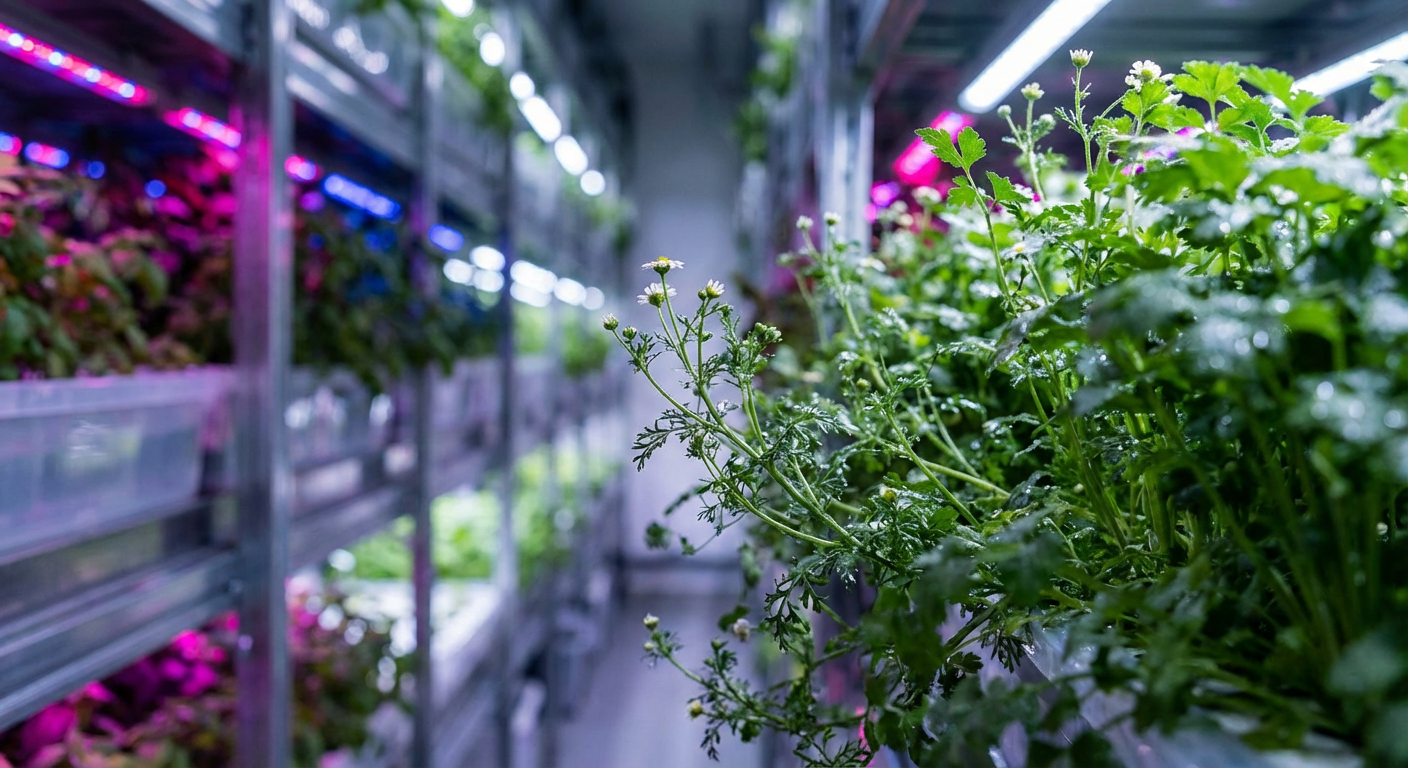
Supernormal Greens leverages Controlled Environment Agriculture (CEA) to establish an intrinsic quality control foundation for its medicinal botanicals. This approach minimizes external variables typically associated with open-field cultivation, enabling precise manipulation of growth factors. By controlling light spectra, temperature, humidity, and nutrient profiles, we can consistently trigger xenohormesis pathways, leading to the upregulation of specific secondary metabolites. This environmental control directly addresses the challenges of botanical variability. For example, specific LED spectra can be tuned to enhance desired volatile compounds and phenolics in Lamiaceae species like Melissa officinalis (Lemon Balm) or Ocimum sanctum (Holy Basil), supporting targeted phytochemical profiles with batch-to-batch consistency. Our proprietary abiotic and biotic stress protocols, including UV-B radiation or selected elicitors, are precisely timed interventions designed to maximize the accumulation of high-value compounds achieving up 3 to 30 times the concentration found in field-grown varieties (independent analysis, CTAEX lab, 2025). This level of control ensures not only potency but also predictable quality for our ingredient buyers and formulators.
Ensuring Purity: Microbial & Contaminant Control in Vertical Farming
Maintaining impeccable purity in botanical ingredients is paramount for cosmetic, nutraceutical, and pharmaceutical applications. While indoor cultivation significantly reduces exposure to environmental contaminants, it introduces its own set of considerations. Reviews on soilless production systems, such as the one published in PMC, highlight the potential for microbial presence from water, seeds, substrates, and equipment even in controlled environments. Supernormal Greens implements stringent protocols to mitigate these risks. Our facility maintains pharma-grade microbial cleanliness through advanced air filtration, sterile seeding practices, and a closed-loop irrigation system that continuously monitors and purifies water. Regular environmental monitoring and validated sanitation procedures prevent the proliferation of pathogenic microorganisms and minimize overall bioburden. This proactive approach ensures our ingredients consistently meet rigorous microbiological specifications, allowing our customers to bypass extensive pre-treatment and purification steps. Our pesticide-free cultivation environments guarantee the absence of harmful agrochemicals, a critical factor given the strict maximum residue limits (MRLs) outlined in regulations like Regulation (EC) 396/2005.
What specific microbiological parameters are guaranteed?
Supernormal Greens guarantees microbial specifications including Total Viable Count (TVC), absence of specific pathogens such as E. coli, Salmonella, and Listeria, and controlled levels of yeasts and molds. Our cultivation environment inherently minimizes exposure to these contaminants, which can be prevalent in field crops. This translates to ingredients with significantly lower microbial load compared to conventional botanicals, requiring less post-harvest processing and reducing downstream formulation risks.
The Supernormal Greens Certificate of Analysis: Your Guarantee of Quality
The Supernormal Greens Certificate of Analysis (CoA) serves as a comprehensive assurance of our botanical ingredients' identity, purity, and potency. Each CoA provides detailed specifications derived from independent analysis by CTAEX laboratories in 2025, ensuring objective validation. This includes quantitative data on key bioactive compounds, microbial parameters, heavy metals, and pesticide absence. For instance, the CoA for Ocimum sanctum (Holy Basil) would detail ursolic acid, rosmarinic acid, and the presence of eugenol (9416 mg/kg) and carvacrol (511 mg/kg) – compounds often absent in field-grown tulsi due to environmental factors. This level of granularity provides ingredient buyers with the precise chemical profile needed for advanced formulation and regulatory submissions. The CoA's traceability elements, detailing origin, batch number, and cultivation parameters, support full European compliance and due diligence requirements.
Meeting Global Regulatory Standards for B2B Botanical Materials
Navigating the complex global regulatory landscape for botanical ingredients requires an acute understanding of diverse standards. Supernormal Greens' processes are designed to align with crucial guidelines, enabling seamless integration into various regulated product categories. The EMA's Guideline on Good Agricultural and Collection Practice (GACP) for herbal starting materials forms a foundational upstream standard for our cultivation practices, ensuring traceability, qualified personnel, and meticulous documentation extending from seed to harvest. Beyond GACP, our operations consider the expectations of Good Manufacturing Practice (GMP) as outlined in EudraLex Volume 4 for medicinal products, and ISO 22716 for cosmetic GMPs. For nutraceutical applications, we adhere to contaminant limits for heavy metals and mycotoxins as specified in Regulation (EU) 2023/915, and microbiological criteria for foodstuffs from Regulation (EC) 2073/2005. This multi-layered compliance approach ensures our ingredients meet diverse market requirements, whether for a cosmetic serum, a functional food product, or a pharmaceutical-grade botanical extract, reducing regulatory hurdles for our clients.
Sustainable Sourcing: Quality Control Beyond the Lab
Sustainability is an integral component of quality control at Supernormal Greens, extending beyond chemical and microbial purity to encompass environmental responsibility and supply chain integrity. With the EU Deforestation Regulation (EUDR) influencing buyer expectations for all plant-derived ingredients by 2027 – even those outside its direct scope – transparent and compliant sourcing is becoming a competitive differentiator. Our vertical farming model inherently supports EUDR compliance by design, as all cultivation occurs within our 7,000 m² Swedish facility. This geographical confinement provides unequivocal geolocation data and verifiable deforestation-free status. Our recent Life Cycle Assessment (LCA) by Martin (2023) demonstrates a carbon footprint of 0.72 kg CO₂-eq/kg, significantly lower than the vertical farm average of 1.9 kg and field-grown imported alternatives at 1.4 kg. This low environmental impact is a direct result of our optimized energy use and waste management within a closed-loop system. By offering 100% EUDR-compliant botanicals, Supernormal Greens provides ingredient buyers with a secure, environmentally responsible supply chain that mitigates risks associated with global supply fluctuations, especially pertinent given the challenges facing natural fragrance tropical supply chains. Vertical farming offers clear advantages in environmental stewardship, enhancing long-term supply chain resilience.
Optimizing Bioactive Compounds Through Precision Cultivation
Precision cultivation is a cornerstone of Supernormal Greens' strategy to consistently optimize and elevate bioactive compound profiles in our medicinal botanicals. Our controlled environment agriculture (CEA) allows us to precisely modulate environmental factors that act as xenohormetic stressors, directly influencing the plant's secondary metabolism. This targeted approach enables us to achieve significantly higher concentrations of desired compounds compared to field-grown plants, along with remarkable batch-to-batch consistency. For example, our internal R&D demonstrated an approximate 9-fold increase in artemisinin yield in Artemisia annua (Sweet Wormwood), reaching 6270 mg/kg compared to typical field cultivation (independent analysis, CTAEX lab, 2025). This precision cultivation method allows us to tailor botanical profiles to meet specific ingredient demands for potency and consistent performance, a crucial advantage for demanding cosmetic, nutraceutical, and pharmaceutical applications.
Frequently Asked Questions
What is pharma-grade quality for botanical ingredients?
Pharma-grade quality for botanical ingredients refers to raw materials that meet stringent standards for identity, purity, potency, and contaminants, aligning with pharmaceutical guidelines such as GACP and GMP. It implies controlled cultivation, validated analytical testing, and comprehensive documentation to ensure safety, efficacy, and batch-to-batch consistency for human use.
How does Supernormal Greens ensure microbial safety?
Supernormal Greens ensures microbial safety through a closed-loop cultivation system, sterile propagation, controlled atmospheric conditions, and strict hygienic protocols. Water is purified and recirculated, and advanced air filtration prevents airborne contaminants. This systematic approach results in pharma-grade microbial cleanliness, significantly reducing contamination risks inherent in traditional agriculture.
Are Supernormal Greens' products pesticide-free?
Yes, all Supernormal Greens botanical ingredients are pesticide-free. Our controlled indoor environment eliminates the need for any chemical pesticides, herbicides, or fungicides. This ensures our products are free from residues, complying with and exceeding stringent regulatory limits for agricultural chemicals.
What is a Certificate of Analysis (CoA) and what details does Supernormal Greens provide?
A Certificate of Analysis (CoA) is a document that verifies an ingredient's quality against specified parameters. Supernormal Greens' CoAs provide detailed quantitative data from independent lab analyses (e.g., CTAEX lab, 2025) including concentrations of key bioactive compounds, microbial counts, heavy metal content, and confirmation of pesticide absence. This comprehensive documentation ensures transparency and compliance.
"A robust Certificate of Analysis is not just a document, it is the bridge between plant biology, analytical validation, and customer trust."
Shirin Moradi. PhD, Senior plant scientist
How does vertical farming impact the consistency of botanical compounds?
Vertical farming significantly enhances the consistency of botanical compounds by precisely controlling environmental variables such as light, temperature, humidity, and nutrient delivery. This eliminates the natural variability seen in field-grown crops, enabling targeted upregulation of secondary metabolites and ensuring predictable, repeatable bioactive profiles batch after batch.
How can Supernormal Greens products meet specific formulation requirements?
Supernormal Greens can meet specific formulation requirements through precision cultivation that optimizes targeted bioactive compounds. By modulating growth conditions and applying xenohormetic stressors, we consistently achieve desired phytochemical profiles and high potency. Our detailed CoAs provide the exact specifications needed for formulators to ensure product performance and compliance.
Key Business Implication
The convergence of increasing regulatory scrutiny, demanding buyer specifications, and global supply chain vulnerabilities underscores the strategic value of high-quality, traceable botanical inputs. Partnering with Supernormal Greens provides a de-risked supply chain and ensures access to pharma-grade plant materials with unparalleled consistency and purity. Contact Supernormal Greens to request samples and specifications.
References
European Medicines Agency. 2025. Guideline on Good Agricultural and Collection Practice (GACP) for starting materials of herbal origin. European Medicines Agency. https://www.ema.europa.eu/en/documents/scientific-guideline/guideline-good-agricultural-collection-practice-gacp-starting-materials-herbal-origin-revision-1_en.pdf
European Medicines Agency. 2022. Guideline on quality of herbal medicinal products/traditional herbal medicinal products (Revision 3). European Medicines Agency. https://www.ema.europa.eu/en/documents/scientific-guideline/final-guideline-quality-herbal-medicinal-productstraditional-herbal-medicinal-products-revision-3_en.pdf
European Commission. 2009. Regulation (EC) No 1223/2009 on cosmetic products. EUR-Lex. https://eur-lex.europa.eu/legal-content/en/TXT/?locale=en&uri=CELEX%3A32009R1223
European Food Safety Authority. 2025. Compendium of botanicals | EFSA. https://www.efsa.europa.eu/en/data-report/compendium-botanicals
Ebrahimi, A., et al. 2025. Microbial Quality of Leafy Greens Grown Under Soilless Production Systems. PMC. https://pmc.ncbi.nlm.nih.gov/articles/PMC12472353/
European Commission. 2023. Commission Regulation (EU) 2023/915 of 25 April 2023 on maximum levels for certain contaminants in food. EUR-Lex. https://eur-lex.europa.eu/eli/reg/2023/915/oj
European Commission. 2005. Commission Regulation (EC) No 2073/2005 of 15 November 2005 on microbiological criteria for foodstuffs. EUR-Lex. https://eur-lex.europa.eu/eli/reg/2005/2073/oj
Council of the European Union. 2025. Deforestation: Council signs off targeted revision to simplify and postpone the regulation. Consilium. https://www.consilium.europa.eu/en/press/press-releases/2025/12/18/deforestation-council-signs-off-targeted-revision-to-simplify-and-postpone-the-regulation/