

What is Eugenol? A Formulator’s Guide to its Antimicrobial and Sensory Properties
Quick answer
The sustained growth in clean beauty and natural product markets has intensified scrutiny on ingredient functionality and origin. As formulators seek multi-functional botanicals, understanding compounds like **eugenol** becomes critical, particularly regarding its antimicrobial, antioxidant, and sensory contributions. This article will explore eugenol's chemical properties, pharmacological actions, and critical considerations for its integration into cosmetic, nutraceutical, and pharmaceutical formulations.
Key Takeaways
Eugenol is a phenylpropanoid with potent antioxidant and antimicrobial properties.
Its multi-functional profile suits cosmetic, nutraceutical, and pharmaceutical applications.
EU allergen regulations necessitate careful formulation and labeling in cosmetics.
Advanced cultivation ensures high-purity, traceable, and EUDR-compliant eugenol.
The Chemical Profile and Natural Origins of Eugenol
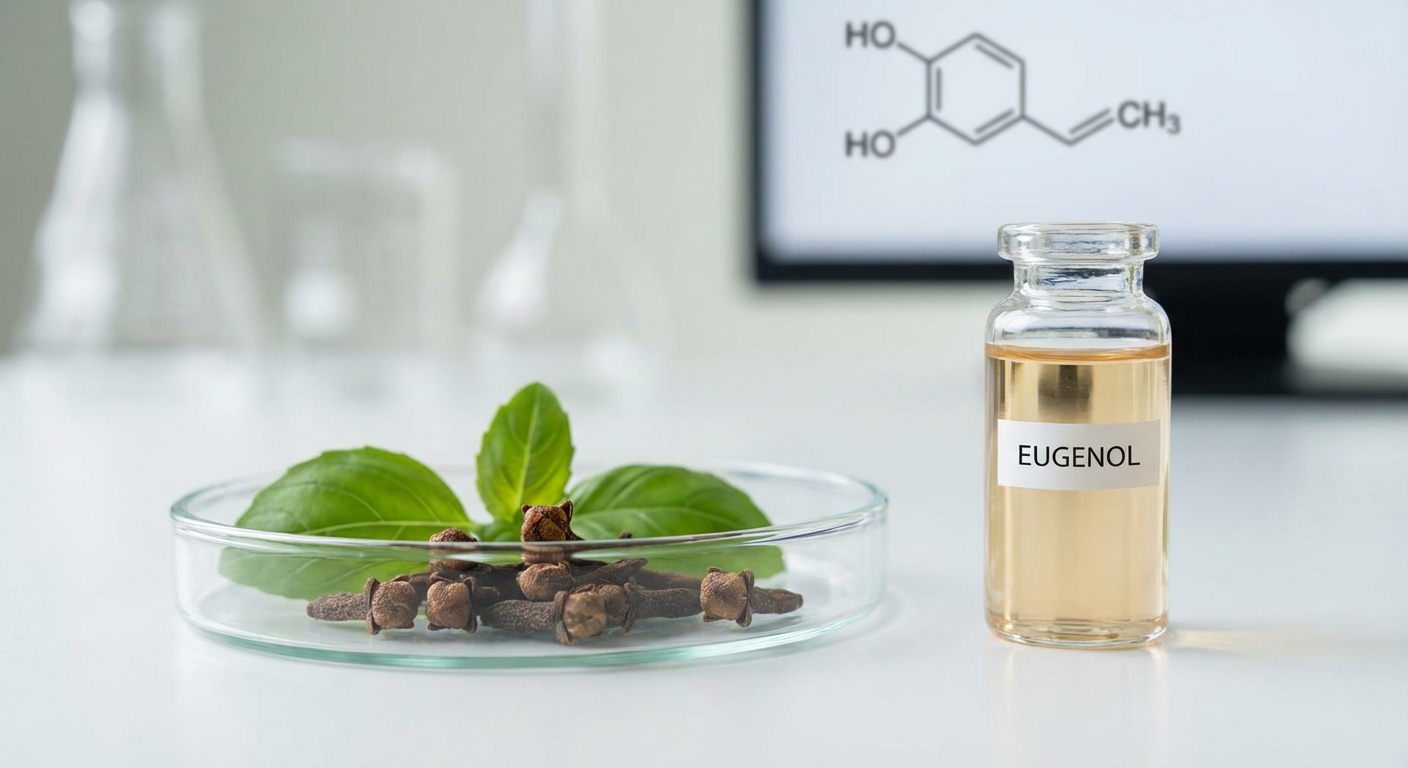
Eugenol is a phenylpropanoid (4-allyl-2-methoxyphenol) characterized by a distinctive clove-like aroma and specific chemical reactivity arising from its allyl, hydroxyl, and methoxy groups on a benzene ring. This compound is not just an aromatic agent; its structure underpins its diverse biological activities. It is the primary active constituent of clove (Syzygium aromaticum) essential oil, often comprising 70-90% of its volume, and is also found in other botanicals such as cinnamon, basil, and nutmeg. This natural abundance positions eugenol as a compelling alternative to purely synthetic compounds, aligning with consumer demand for natural ingredients. However, its isolation and purification process are crucial for ensuring its quality and efficacy in end products. The consistency of natural sourcing and the purity profile are paramount for ingredient buyers.
Pharmacological Functions: A Deeper Dive into Eugenol's Benefits
Eugenol’s functional utility extends across several critical areas, making it a valuable active in various applications. Its well-documented efficacy stems from its capacity to modulate diverse biological pathways. One key attribute is its potent **antioxidant activity**. Eugenol effectively scavenges free radicals, reducing oxidative stress and protecting cellular structures, as demonstrated in multiple *in vitro* and *in vivo* studies. This makes it relevant for formulations requiring oxidative stability or targeting age-related concerns. Beyond antioxidant effects, eugenol exhibits significant **anti-inflammatory properties**. Research indicates its ability to modulate signaling pathways involved in inflammatory responses, including the Nrf2/HO-1 pathway. This mechanism suggests its potential in formulations aimed at reducing redness or irritation. Simultaneously, eugenol possesses notable **antimicrobial and antiseptic characteristics**, effective against various bacteria and fungi. Its capacity to inhibit biofilm formation further supports its utility in applications requiring broad-spectrum microbial control. These characteristics make eugenol a compelling choice for multi-functional cosmetic and nutraceutical developments.
Eugenol in Cosmetics: Safety, Efficacy, and Regulatory Considerations
The integration of eugenol into cosmetic formulations presents unique opportunities and regulatory requirements due to its strong biological activity and classification as an allergen. Its antioxidant, anti-inflammatory, and antimicrobial properties position it as a valuable ingredient for product efficacy. For example, a patent exists for anti-aging and anti-inflammatory cosmetic compositions including eugenol, illustrating its value proposition in advanced formulations. However, formulators must navigate its status as a potential contact allergen. The European Commission's Scientific Committee on Consumer Safety (SCCS) mandates labeling requirements when eugenol concentrations exceed 0.001% in leave-on products and 0.01% in rinse-off products. The Cosmetic Ingredient Review (CIR) Expert Panel also evaluates eugenol's safetyو offering additional guidance on safe concentration limits and usage contexts. These guidelines necessitate precise formulation to maximize benefit while ensuring compliance and consumer safety.
Beyond Cosmetics: Applications in Nutraceuticals and Pharmaceuticals
Eugenol's established pharmacological profile extends its utility significantly beyond cosmetic formulations, finding robust applications in the nutraceutical and pharmaceutical sectors. In nutraceuticals, its compelling antioxidant and anti-inflammatory attributes make it an ingredient of interest for dietary supplements targeting systemic wellness and immune support. The systematic review in 2022 highlighted eugenol as a potent natural antioxidant, reinforcing its potential for internal applications. In the pharmaceutical realm, eugenol’s analgesic and antiseptic properties have a long history, particularly in dentistry. It retains its role in dental preparations for pain relief and microbial control, as supported by its inclusion in pharmacopeial standards. The demand for such high-purity phytochemicals is growing, with market analysts predicting continued expansion in related industries. Vertical farming offers a controlled environment to produce pharmaceutical-grade botanicals, including those high in eugenol, ensuring consistent purity and minimizing contaminants.
Ensuring Quality: Sourcing and Standards for High-Purity Eugenol
The quality of botanical ingredients is directly correlated with their cultivation and processing methodology. For high-purity eugenol, particularly for pharmaceutical or high-end cosmetic applications, stringent control over sourcing is non-negotiable. Standard field cultivation introduces variability in phytochemical profiles, microbial load, and potential pesticide residues. Vertical farming, leveraging proprietary abiotic and biotic stress protocols such as UV-B exposure or elicitor application, allows for significant upregulation of secondary metabolites, including eugenol. This controlled environment ensures both enhanced potency – often 3–30 times higher than field-grown counterparts – and unparalleled batch-to-batch consistency. Furthermore, the contained nature of vertical farms inherently provides pharma-grade microbial cleanliness and guarantees zero pesticide use, a critical advantage in the current regulatory landscape. Each batch production is fully traceable, adhering to European standards and providing a substantial competitive edge as global supply chains face increasing scrutiny under regulations like EUDR.
Market Trends and Future Prospects for Eugenol
The market outlook for eugenol is positioned for continued growth, driven by converging trends across several industries. The demand for natural preservatives, active botanicals, and clean-label ingredients continues to accelerate across cosmetics and nutraceuticals. This aligns with eugenol's multi-functional profile. Furthermore, the ongoing natural fragrance tropical supply shortage is elevating the value of sustainably sourced terpenes and aromatic compounds like eugenol, leading to significant market premiums. Regulatory changes, such as the EU Critical Raw Materials Act and the imminent implementation of EUDR (which could render 35–55% of tropical supply chains non-compliant by 2027), are poised to further disrupt traditional botanical sourcing. This creates a strategic advantage for domestically produced, EUDR-compliant ingredients. For instance, the precise control over bioactive compounds in plants like Ocimum sanctum cultivated in vertical farms ensures not only an abundant source of eugenol (9416 mg/kg from Supernormal Greens' Ocimum sanctum vs. negligible in field varieties) but also a consistent, high-ppurity profile essential for meeting evolving market demands and regulatory compliance.
Frequently Asked Questions
What is the purity profile of your eugenol extract and how is it tested?
Our eugenol extracts achieve pharmaceutical-grade purity, confirmed by independent analysis (CTAEX lab, 2025). We utilize advanced spectroscopic and chromatographic methods, including GC-MS and HPLC, to quantify eugenol content and detect any impurities, ensuring a consistent and high-quality profile for every batch.
Can your eugenol be sourced sustainably and how can you demonstrate EUDR compliance?
Yes, our eugenol is sourced from botanicals cultivated in our Swedish vertical farm, rendering it 100% EUDR-compliant by design. Our LCA (Martin, 2023) shows a CO₂-eq/kg footprint of 0.72, significantly lower than the vertical farm average (1.9) and imported alternatives (1.4), underscoring our environmental sustainability.
What are the typical cosmetic applications for your eugenol, considering EU allergen regulations?
Our eugenol can be integrated into cosmetic formulations for its antioxidant, antimicrobial, and anti-inflammatory properties, suitable for applications such as anti-aging serums, blemish treatments, and oral care products. Formulators must adhere to EU allergen labeling thresholds of 0.001% for leave-on and 0.01% for rinse-off products.
Do you offer different grades or concentrations of eugenol for specific industrial uses?
Yes, we provide eugenol extracts tailored to specific industrial requirements, ranging from high-purity pharmaceutical grades to standardized concentrations for cosmetic and nutraceutical applications. Our internal R&D capabilities allow for customized profiles based on client demand.
What data do you have on the antioxidant and anti-inflammatory efficacy of your eugenol?
Our internal R&D, supported by independent analysis (CTAEX lab, 2025), demonstrates potent antioxidant activity through free radical scavenging assays and significant anti-inflammatory efficacy via modulation of key inflammatory markers. These findings contribute to the robust pharmacological profile of our eugenol.
Are there any specific formulation challenges or incompatibilities when using eugenol?
Eugenol's strong aroma and potential for oxidation require careful formulation design. It can interact with certain excipients and may require encapsulation or antioxidant co-formulation to maintain stability and mitigate sensory impact, particularly in sensitive matrices.
How does your eugenol compare to synthetic alternatives in terms of biological activity and cost?
Our plant-derived eugenol consistently exhibits superior biological activity due to its full phytochemical matrix and robust purity, often surpassing synthetic alternatives in efficacy. While initial cost may vary, the enhanced performance and natural origin of our eugenol provide a strong value proposition, particularly as market premiums for natural ingredients rise.
What regulatory documentation can you provide for eugenol in nutraceutical or pharmaceutical applications?
We provide comprehensive documentation including Certificates of Analysis (CoA), full European traceability records, and detailed specifications aligning with relevant pharmacopeial standards. Our data supports safe and compliant use in both nutraceuticals and pharmaceuticals, including Novel Food considerations where applicable.
Closing
The strategic integration of high-purity eugenol into formulations offers formulators a proven multi-functional component with significant antimicrobial, antioxidant, and sensory attributes. Sourcing from vertically farmed botanicals under strict controls ensures an EUDR-compliant, consistent, and potent ingredient, addressing critical market needs and regulatory pressures. This approach guarantees unparalleled bat-to-batch consistency and a favorable sustainability footprint. Contact Supernormal Greens to request samples and specifications.
References
Ljusgårda AB / CTAEX Laboratory. 2025. Certificate of Analysis — _Ocimum sanctum_. Independent analytical testing.
Prasad, S. P., et al. 2020. Eugenol: A Natural Antioxidant: A Systematic Review. Journal of Essential Oil Bearing Plants. https://pubmed.ncbi.nlm.nih.gov/36017042/
Neves, M. A., et al. 2012. Eugenol: a review of its pharmacology, and potential applications in animal models of disease. The Scientific World Journal. https://pubmed.ncbi.nlm.nih.gov/22619092/
Barabaszova, K., et al. 2022. Eugenol (4-allyl-2-methoxyphenol) from Syzygium aromaticum (L.) Merr. & L.M. Perry: A new perspective on its antioxidant and anti-inflammatory properties. International Journal of Molecular Sciences. https://www.ncbi.nlm.nih.gov/pmc/articles/PMC3735165/
Prasad, S. P., et al. 2020. Eugenol as a Natural Antioxidant: A Systematic Review. Journal of Essential Oil Bearing Plants. https://pubmed.ncbi.nlm.nih.gov/36017042/
Rasool, M., et al. 2018. Eugenol as an Anti-Inflammatory Agent via Regulation of the Nrf2/HO-1 Pathway. Oxidative Medicine and Cellular Longevity. https://pubmed.ncbi.nlm.nih.gov/29841808/
Cove, P., et al. 2012. Antimicrobial Activities of Clove (Syzygium aromaticum) Extract and Eugenol as Key Component. Natural Product Research. https://www.ncbi.nlm.nih.gov/pmc/articles/PMC3606558/
Chaieb, K., et al. 2017. Current knowledge about eugenol: A natural compound with potential applications in periodontal medicine. Journal of Oral Microbiology. https://www.ncbi.nlm.nih.gov/pmc/articles/PMC8956961/
Dwivedi, S., et al. 2021. Eugenol and Its Derivatives: A Review of Their Anti-biofilm Activity. Applied Biochemistry and Biotechnology. https://www.ncbi.nlm.nih.gov/pmc/articles/PMC8122396/
Sarvesh Kumar, S., et al. 2017. Eugenol: a review on the role of eugenol in different medical ailments. Asian Journal of Pharmaceutical and Clinical Research. https://www.ncbi.nlm.nih.gov/pmc/articles/PMC5468759/
European Commission. 2022. SCCS Opinion on fragrance allergens in cosmetic products - revision.j/https://health.ec.europa.eu/document/download/32a999f7-d820-496a-b659-d8c296cc99c1_en?filename=sccs_o_273_final.pdf&prefLang=es&utm_source=chatgpt.com
Park, S. M., et al. 2016. Anti-aging and anti-inflammatory cosmetic composition. WO2016187766A1. https://patents.google.com/patent/WO2016187766A1/en
European Food Safety Authority. Novel food. https://www.efsa.europa.eu/en/topics/topic/novel-food
Martin, S. 2023. Life Cycle Assessment of Vertical Farm Operations. Internal Report, Ljusgårda AB.https://www.sciencedirect.com/science/article/pii/S2352550923001525