

The Role of Adaptogens in Anti-Aging: A Deep Dive into Tulsi's Cellular Mechanisms
Quick answer
The global adaptogens market is projected to reach USD 16.3 billion by 2030, driven by expanding applications in functional foods, beverages, and cosmetics. This growth reflects increasing consumer demand for natural solutions, yet supply chain inconsistencies for field-grown botanicals remain a critical challenge. This article examines the cellular mechanisms and clinical evidence for adaptogens in anti-aging skincare, focusing on robust data and regulatory considerations for B2B buyers.
Key Takeaways
Adaptogens modulate cellular resilience pathways relevant to skin aging.
Clinical data supports topical ashwagandha, ginseng, and Centella for wrinkles and elasticity.
EU & US regulations necessitate robust data for cosmetic claims and safety.
Vertical farming reduces supply variability and enhances traceability for adaptogens.
What Are Adaptogens Doing in Anti‑Aging Skincare?
Adaptogens are botanicals that enhance the body’s ability to resist physical, chemical, and biological stressors, restoring homeostasis. In anti-aging skincare, they modulate cellular pathways involved in stress response, inflammation, and extracellular matrix (ECM) integrity. This translates to potential benefits for wrinkles, elasticity, hydration, and overall skin resilience.
The skin–brain–stress axis directly impacts dermal aging, with chronic stress leading to increased cortisol levels that can degrade collagen and impair the skin barrier. Adaptogens offer a pathway to mitigate these effects through various mechanisms:
Oxidative Stress Reduction: Activation of endogenous antioxidant pathways, like Nrf2.
Inflammation Modulation: Inhibition of pro-inflammatory cytokines and pathways.
ECM Protection: Prevention of metalloproteinase (MMP) activity and stimulation of collagen/elastin synthesis.
Barrier Support: Upregulation of key barrier proteins to reduce transepidermal water loss (TEWL).
For example, some adaptogens like Ocimum sanctum (Holy Basil) contain compounds such as ursolic acid and rosmarinic acid, which have demonstrated significant antioxidant and anti-inflammatory properties potentially supporting improved skin health.
The Stress-Skin Connection
Chronic psychological stress elevates cortisol, leading to accelerated skin aging. Oral adaptogens like ashwagandha have shown promise in managing systemic stress. A systematic review and meta-analysis of RCTs highlights oral ashwagandha's ability to lower serum cortisol in stressed adults. This supports an "inside-out" approach where nutricosmetics are paired with topical treatments, targeting the stress-skin axis.
Clinically Tested Adaptogens: What the Human Data Shows
Clinical evidence provides the strongest substantiation for adaptogen efficacy in anti-aging skincare, focusing primarily on topical applications and specific biophysical endpoints. Randomized controlled trials offer valuable insights for product development.
Ashwagandha (Withania somnifera) has demonstrated skin benefits in human trials. A randomized, placebo-controlled clinical trial found that an 8% topical ashwagandha lotion, applied twice daily for 60 days, significantly improved dermatologist-rated wrinkles, hydration, and elasticity in photoaged adults, alongside reduced TEWL.
Ginseng and Centella Asiatica
Ginseng (Panax spp.) also shows clinical relevance. An RCT involving 78 participants demonstrated that oral enzyme-treated red ginseng, taken for 24 weeks, reduced eye-wrinkle roughness and increased skin elasticity.
For Centella asiatica (Gotu Kola), a double-blind randomized trial revealed that a combination of 5% topical L-ascorbic acid and 0.1% madecassoside (a key Centella triterpene) significantly improved wrinkles, firmness, and hydration over six months in photoaged women. This combination also led to elastic fiber remodeling in the papillary dermis.
Key clinical findings for adaptogens in anti-aging include:
Ashwagandha 8% Topical: Improved wrinkles, hydration, and elasticity, reduced TEWL over 60 days.
Oral Red Ginseng: Decreased eye-wrinkle roughness and enhanced elasticity over 24 weeks.
Panax ginseng Leaf Extract 0.05% Topical: Reduced deep furrow depth in an 8-week pilot study.
Madecassoside 0.1% + Vitamin C 5% Topical: Improved deep/superficial wrinkles, suppleness, firmness, and hydration over 6 months.
Mechanisms: From Nrf2 and MMPs to Collagen Remodeling
Adaptogens exert their anti-aging effects through diverse molecular mechanisms that target oxidative stress, inflammation, and structural protein degradation. These mechanisms are crucial for maintaining skin integrity and function.
One primary mechanism involves the activation of the Nrf2/Keap1 pathway. Nrf2 is a master regulator of antioxidant and detoxification genes. Fermented Rhodiola rosea, for instance, protected UVA-damaged fibroblasts by activating Nrf2/Keap1, inhibiting MMP-1/3, and increasing collagen, elastin, and hyaluronic acid production in preclinical studies.
Collagen and Elastic Fiber Protection
Many adaptogens also influence the extracellular matrix directly. Ginsenoside Rb3, a compound found in Panax ginseng, promotes collagen I synthesis via the TGF-β pathway. Centella triterpenes are also known to upregulate collagen and modulate inflammatory responses, contributing to improved skin structure and reduced wrinkle appearance.
Mechanistic pathways contributing to adaptogen anti-aging efficacy:
Nrf2 Activation: Enhances antioxidant defense and cellular detoxification.
MMP Inhibition: Prevents degradation of collagen and elastin by matrix metalloproteinases.
TGF-β Signaling: Stimulates collagen I synthesis and promotes ECM remodeling.
Anti-inflammatory Effects: Reduces inflammation-induced damage to skin structure.
Hyaluronic Acid Production: Increases skin hydration and viscoelasticity.
Barrier Integrity: Schisandra and Centella as Cohesion Builders
Maintaining skin barrier integrity is fundamental for healthy, resilient skin, preventing moisture loss and protecting against environmental aggressors. Certain adaptogens demonstrate significant potential in reinforcing this crucial barrier function.
Schisandra chinensis stem extract and its active compound, schisandrin B, have shown promising results in restoring barrier proteins. In an in vivo mouse model, these compounds were found to restore filaggrin (FLG), loricrin (LOR), and claudin-1 levels, simultaneously reducing TEWL and suppressing NF-κB/TRPV1 pathways, indicative of reduced inflammation and pruritus.
Mechanisms of Barrier Support
Centella asiatica, while primarily known for collagen remodeling, also contributes to barrier function indirectly through its anti-inflammatory effects and ability to improve overall skin health. The presence of madecassoside and asiaticoside aids in reducing inflammation and promoting tissue repair, thereby supporting robust skin barrier function.
Mechanisms impacting skin barrier integrity:
Upregulation of Structural Proteins: Filaggrin, loricrin, and claudins vital for barrier formation.
TEWL Reduction: Directly improves the skin's ability to retain moisture.
Anti-inflammatory Action: Mitigates damage to barrier components caused by inflammation.
Enhanced Lipid Synthesis: Supports the intercellular lipid matrix crucial for barrier cohesion.
For formulators evaluating alternatives, tulsi extract offers complementary bioactives worth considering for comprehensive skincare formulations.
Formulation Benchmarks and Evidenced Use‑Levels
Successful formulation of adaptogen-based anti-aging products relies on understanding effective concentrations and the integration of robust clinical substantiation. Effective ingredient percentages are derived directly from human trials.
Clinical data provides clear benchmarks for specific adaptogens. Topical ashwagandha extract has demonstrated efficacy at an 8% concentration, applied twice daily for 60 days. For ginseng, a 0.05% Panax ginseng leaf extract lotion showed effects over 8 weeks. In another compelling example, 0.1% madecassoside paired with 5% L-ascorbic acid yielded significant results over six months.
Biomarkers and Assay Methods
To substantiate wrinkle and elasticity claims, various assay methods and biomarkers are utilized. These include instrumental evaluations that provide quantifiable data:
Cutometry & Elastometry: Measures skin elasticity (R-parameters, e.g., R2 for gross elasticity).
Profilometry (Fringe Projection & Replica Analysis): Quantifies wrinkle depth, length, and volume.
Transepidermal Water Loss (TEWL): Assesses barrier function and hydration.
Corneometry: Measures skin hydration levels.
Dermatologist and Subject Global Aesthetic Scores: Provide qualitative assessments of improvement.
These methods align with published adaptogen trials, enabling direct comparison and substantiation of product efficacy. For specific formulation challenges, considering SNG tulsi anti aging formulation could provide a relevant benchmark.
Safety, Quality, and Regulatory Considerations (EU & US)
Navigating the regulatory landscape for adaptogens in skincare requires meticulous attention to safety substantiation, claims compliance, and quality control. Both EU and US regulations impose distinct requirements.
In the EU, cosmetic products must adhere to Regulation (EC) No 1223/2009. Cosmetic claims must meet the common criteria outlined in Regulation (EU) No 655/2013, requiring robust documentary evidence for all efficacy and safety statements.
US Regulatory Framework: MoCRA
The US regulatory framework, governed by the FDA, distinguishes between cosmetics and drugs. Anti-aging appearance claims are permissible for cosmetics, but claims implying a structural/functional effect on the body would classify the product as a drug. The Modernization of Cosmetics Regulation Act of 2022 (MoCRA) introduced significant new requirements.
Facility Registration: Mandatory for all cosmetic manufacturing and processing facilities.
Product Listing: All cosmetic products must be listed with the FDA.
Safety Substantiation: Cosmetic products must have adequate safety substantiation.
Adverse Event Reporting: Companies must report serious adverse events.
For oral adaptogens, particular vigilance is necessary. Ashwagandha, while promoting systemic stress reduction, has been linked to herb-induced liver injury (HILI) in case series. This necessitates rigorous supplier qualification, identity testing, and clear contraindication statements for oral formats.
Supply and Sustainability: Why Vertical‑Farmed Botanicals Win
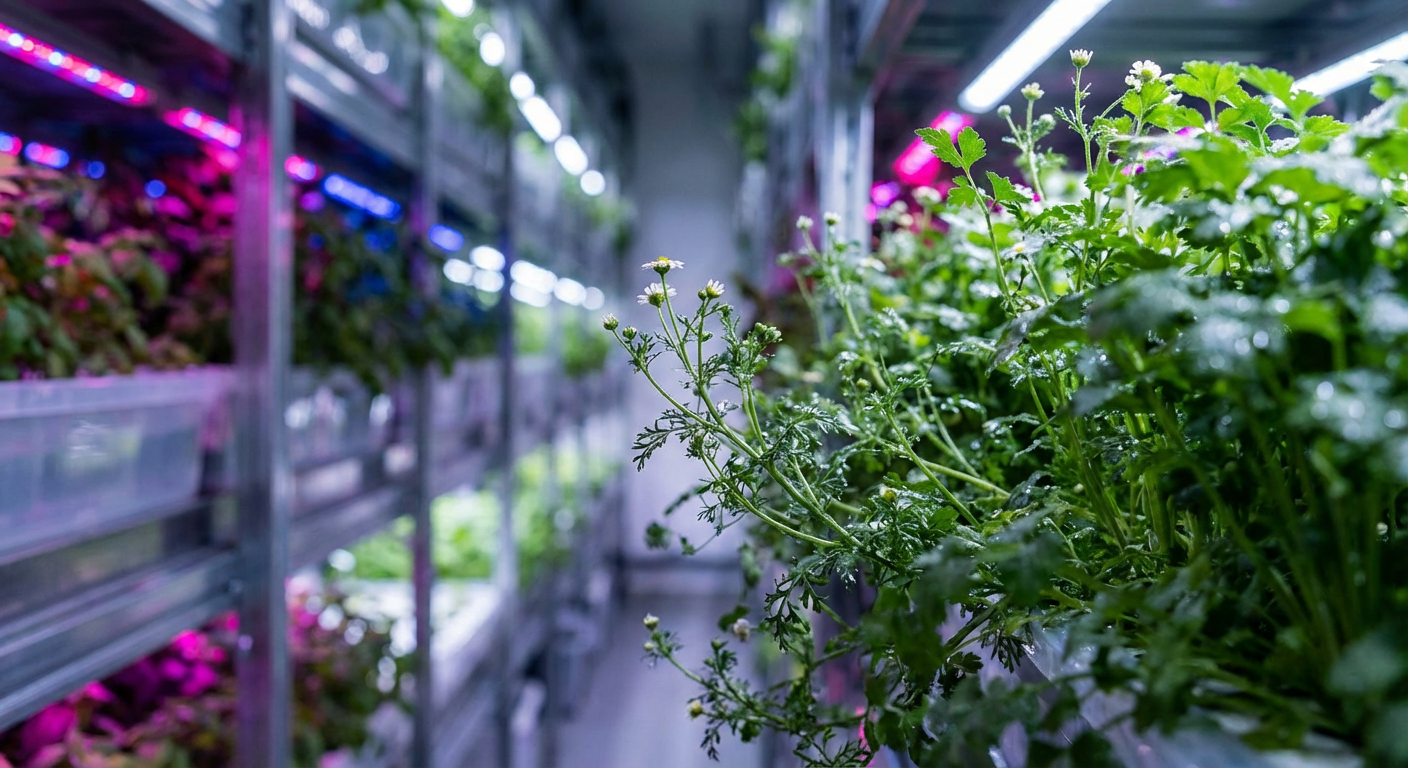
The growing demand for adaptogens exacerbates supply chain fragilities inherent in conventional agriculture. Vertical farming offers a solution by providing consistent, high-quality, and sustainably produced botanicals.
Conventional sourcing of adaptogens often involves wild harvesting or field cultivation, leading to issues such as botanical identity fraud, inconsistent phytochemical profiles, microbial contamination, and dependency on volatile climatic conditions. These challenges directly impact product quality and claim substantiation.
Advantages of Vertical Farming
Vertical farms negate these challenges by controlling environmental parameters. This precise control ensures optimal conditions for secondary metabolite production, leading to standardized phytochemical profiles batch-to-batch. For example, Melissa officinalis (Lemon Balm) grown in vertical farms can achieve up to a 30x increase in rosmarinic acid compared to field-grown counterparts.
Phytochemical Consistency: Ensures target compounds (e.g., madecassoside, withanolides) meet specifications. Independent analysis by CTAEX lab (2025) confirms consistent potency.
Microbial Cleanliness: Pharma-grade microbial cleanliness due to controlled environments, critical for sensitive cosmetic and nutraceutical applications.
Zero Pesticides: Eliminates pesticide residues, meeting stringent quality standards.
Full European Traceability: Complete transparency from seed to extract, complying with regulatory demands.
Sustainability: Lower environmental footprint; a 2023 LCA by Martin shows 0.72 kg CO₂-eq/kg, significantly less than conventional farming.
Furthermore, the EU Deforestation Regulation (EUDR) is making 35–55% of tropical supply non-compliant by 2027. Vertical farming inherently offers EUDR compliance by design, providing a deforestation-free source for botanical ingredients.
Where the Market Is Going: Demand, IP, and White‑Space
The adaptogen market is experiencing substantial growth, driven by consumer inclination towards natural solutions and a heightened awareness of stress-related health issues. This growth, coupled with regulatory shifts, creates both opportunities and strategic white-space.
The global adaptogens market is projected to reach approximately USD 16.3 billion by 2030, with personal care and cosmetics being key growth sectors. This sustained demand, however, places pressure on the supply chains for many adaptogens, which predominantly originate from field-grown or wild-harvested sources.
Intellectual Property and Market Differentiation
Opportunities for intellectual property (IP) development are emerging. For example, a 2013 US patent family highlights Schisandra sphenanthera extracts for cosmetic compositions targeting barrier and homeostasis benefits. This signals the potential for differentiated IP protection around specific adaptogen applications and novel compounds.
Key market drivers and white-space opportunities:
Rising Consumer Demand: For natural, sustainable, and transparent ingredients.
Clean Beauty Movement: Drives demand for pesticide-free, sustainably sourced botanicals.
"Stress-Skin" Positioning: The intersection of mental wellness and dermatological health creates a unique market segment.
IP Development: Opportunities for novel applications or proprietary extraction methods for adaptogens.
Traceability & Compliance: Vertical farm advantages align with stringent regulatory demands.
Frequently Asked Questions
What concentrations and assay methods substantiate wrinkle and elasticity claims for adaptogen actives?
Wrinkle reduction and elasticity claims for adaptogen actives are typically substantiated with topical concentrations such as 8% for ashwagandha extract, 0.05% for Panax ginseng leaf extract, and 0.1% madecassoside combined with 5% L-ascorbic acid. Assay methods include cutometry for elasticity (R-parameters), profilometry for wrinkle depth, and dermatological visual grading.
How do we build an EU 655/2013‑compliant claims file for an adaptogen serum?
To build an EU 655/2013-compliant claims file for an adaptogen serum, you must gather clear, robust evidence, often from clinical trials, demonstrating the claimed effects. This evidence should be scientifically sound, reproducible, and specific to the finished product, covering areas like efficacy, safety, and stability, all while adhering to the common criteria for cosmetic claims.
Can we pair a topical adaptogen serum with an oral nutricosmetic without creating drug‑like claims?
Yes, topical adaptogen serums can be paired with oral nutricosmetics, but it is crucial to carefully separate the claims. Topical claims must focus on cosmetic benefits (e.g., improved skin appearance, hydration), while oral nutricosmetic claims must remain within the scope of dietary supplements (e.g., supporting general well-being, stress reduction), avoiding any implication of treating or preventing disease.
Which biomarkers (TEWL, R2, profilometry) best align with published adaptogen trials?
For adaptogen trials, Transepidermal Water Loss (TEWL) aligns well with barrier support claims, R2 (gross elasticity) from cutometry with elasticity improvements, and profilometry with wrinkle reduction. These instrumental measurements provide objective, quantifiable data that aligns with clinical findings for various adaptogens.
How do vertical‑farm CoAs map to targeted withanolide/ginsenoside/madecassoside specs?
Vertical farm Certificates of Analysis (CoAs) map to targeted phytochemical specifications by detailing the precise concentrations of key active compounds like withanolides, ginsenosides, or madecassoside. Controlled environment agriculture ensures consistent metabolite production, thereby enabling batch-to-batch standardization of these compounds, which is critical for product consistency and claim substantiation.
What are the contraindication statements B2B buyers should include for oral ashwagandha?
For oral ashwagandha, B2B buyers should include contraindications for pregnancy/lactation, caution for individuals with thyroid disorders, liver disease, or those taking other hepatotoxic or CNS-depressant medications. It's also vital to monitor emerging national advisories from health authorities like ANSES or the UK FSA.
How do we differentiate Schisandra vs Centella for barrier claims in marketing language?
To differentiate Schisandra from Centella for barrier claims: emphasize Schisandra's direct action on key barrier proteins like filaggrin and loricrin, and its role in reducing TEWL. For Centella, highlight its broader reparative and anti-inflammatory benefits that indirectly support a healthy barrier, such as collagen synthesis and tissue regeneration.
What are the IP risks around using Schisandra extracts in barrier‑focused formulas?
IP risks around using Schisandra extracts in barrier-focused formulas include navigating existing patents, such as those related to Schisandra sphenanthera extracts for cosmetic barrier benefits. Formulators must conduct thorough patent Landscape analyses to ensure freedom to operate or explore licensing opportunities for specific novel applications or compositions.
How do MoCRA listing and safety substantiation requirements affect launch timelines?
MoCRA's mandatory facility registration, product listing, and safety substantiation requirements can extend launch timelines for cosmetic products in the US. Companies need to allocate additional time for preparing and submitting documentation, ensuring all safety data is in place, and confirming compliance with new labeling and adverse event reporting mandates.
Which markets (geographies) are most receptive to stress‑skin positioning?
Markets in North America, Western Europe, and parts of Asia (e.g., Japan, South Korea) are highly receptive to stress-skin positioning. These regions typically have high disposable incomes, advanced wellness industries, and consumers who are increasingly aware of the connection between psychological stress and dermatological health. The strategic integration of adaptogens into anti-aging formulations represents a significant opportunity for innovation. By leveraging clinically supported data and adhering to evolving regulatory frameworks, formulators can develop compelling products responsive to market demand. Vertical farming methods further ensure supply chain integrity and ingredient consistency. Contact Supernormal Greens to request samples and specification.