

95% Less Water, 100% More Consistency: The Sustainability Argument for CEA-Grown Ingredients

Quick answer
Mounting global water scarcity and increasing regulatory pressures like the EUDR are forcing B2B buyers to re-evaluate ingredient sourcing, particularly for botanicals. Water usage in traditional agriculture presents a significant environmental and economic challenge. This article quantifies the water efficiency of vertical farming and its implications for consistent, high-purity botanical ingredients.
Key Takeaways
Vertical farms reduce water usage by 70–95% compared to field agriculture.
Closed-loop irrigation systems enable up to 95% water recycling, minimizing loss.
Water efficiency supports consistent phytochemical profiles and high purity botanicals.
Reduced water footprint and minimal runoff align with high sustainability standards.
Water Efficiency of Vertical Farms vs Traditional Agriculture
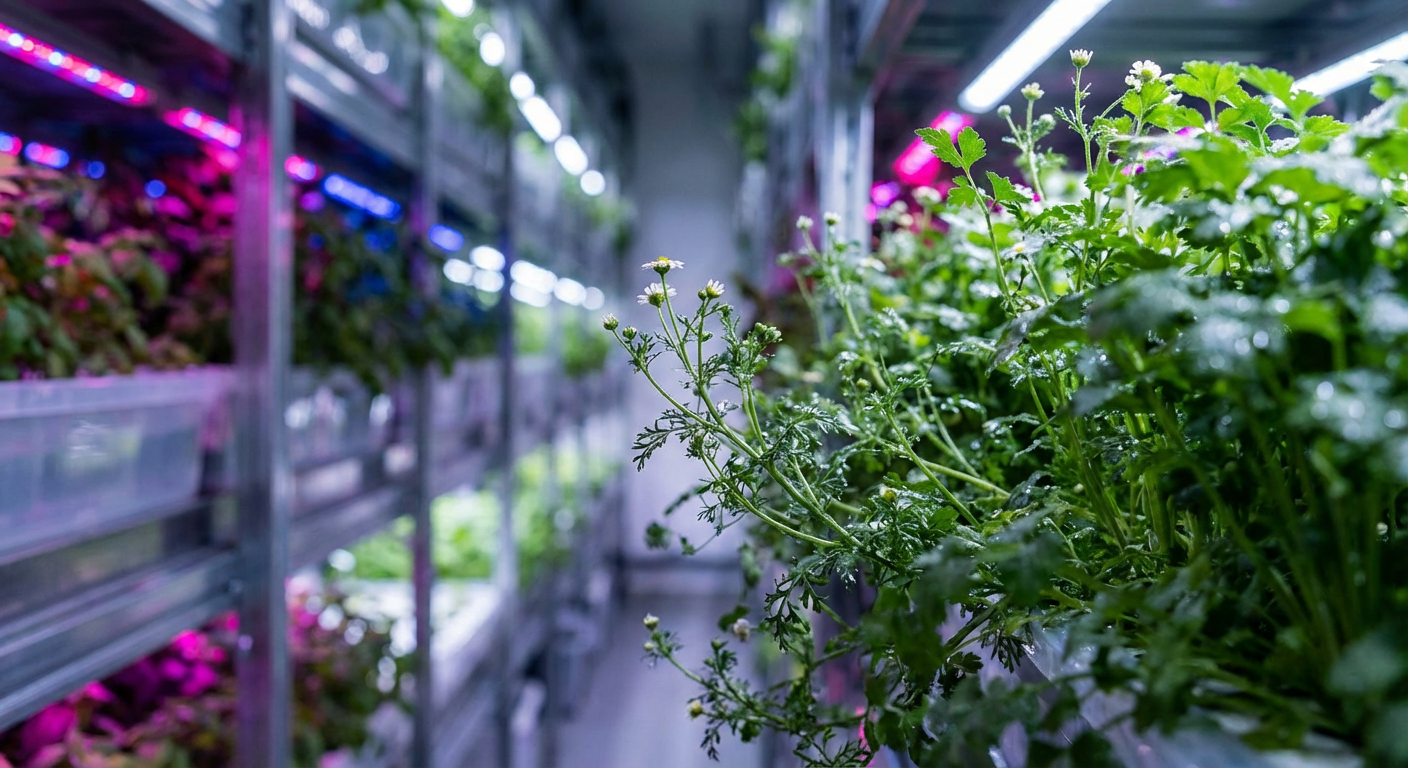
Vertical farming significantly decreases agricultural water consumption compared to traditional field cultivation. Indoor vertical farms integrating advanced hydroponic and aeroponic systems reduce water usage by 70–95% per kilogram of produce. This marks a substantial improvement over conventional methods. A Frontiers review confirmed that controlled environment agriculture (CEA) uses 70–95% less water than soil-based agriculture. Such efficiency is crucial given growing demands on freshwater resources.
Comparative Water Consumption
An MDPI review of vertical farming water use indicated up to an 18-fold reduction in water per kg dry lettuce when compared to surface irrigation. This advantage extends to a 9-fold reduction against drip irrigation. The inherent design of CEA systems minimizes evaporative and runoff losses.
Cultivation Method | Approximate Water Usage (L/kg produce) | Reference |
|---|---|---|
Traditional (Soil-based) | 200–250 (lettuce average) | SAGE journal, 2021 |
Traditional (Soil-based) | 2017 (median, leafy greens) | Frontiers review, 2025 |
Vertical Farm (CEA) | 6.1 (lettuce average) | SAGE journal, 2021 |
Vertical Farm (CEA) | 62 (median, leafy greens) | Frontiers review, 2025 |
An environmental comparison table in the European Journal of Horticultural Science illustrated a 90% reduction, with vertical farms using approximately 20 L/kg of produce versus 200 L/kg in traditional farming. These quantitative differences are fundamental to sustainable ingredient sourcing.
Quantitative Analysis: Water Usage Metrics in Controlled-Environment Systems
Quantitative metrics demonstrate the superior water efficiency of CEA. Precise control over nutrient delivery and atmospheric conditions minimizes waste. This allows for optimized plant uptake and minimal environmental discharge. A case study from a Chicago vertical farm published in SAGE journal highlighted the substantial difference. It found that indoor vertical farms used approximately 6.1 L/kg of water for lettuce. Conventional open-field lettuce required around 250 L/kg, indicating a 90–95% reduction.
Water Conservation Mechanisms
Recirculation: Nutrient-rich water is continuously captured, filtered, and re-supplied to plants.
Evapotranspiration Capture: Evaporated water from plants is condensed and returned to the system.
Precision Dosing: Sensors monitor plant needs and deliver exact water and nutrient quantities.
Absence of Runoff: No water is lost to soil absorption or surface runoff, preventing environmental contamination.
These mechanisms collectively contribute to significantly reduced water footprints. For ingredient buyers, this translates to sourcing inputs with a demonstrably lower environmental impact.
Closed‑Loop Irrigation and Resource Circularity
Closed-loop irrigation systems are a hallmark of advanced vertical farming, enabling near-total water recycling. These systems prevent water and nutrient losses common in traditional agriculture, supporting resource circularity. By recirculating irrigation water, vertical farms maintain a consistent water supply irrespective of external climate conditions.
A report from ShunWaste states that closed-loop systems recycle up to 95% of water. This recycling minimizes losses from evaporation and runoff, critical for maintaining resource efficiency.
Advantages of Closed-Loop Systems
Maximized Water Reuse: Water is constantly filtered and replenished, ensuring minimal waste.
Nutrient Optimization: Unused nutrients are recaptured and redelivered, improving resource efficiency.
Reduced Contamination Risk: Filtration processes remove impurities, preventing external pollutants from reaching plants.
Stable Growing Environment: Consistent water and nutrient delivery contribute to batch-to-batch predictability.
This environmental control is crucial for high-value medicinal botanicals, ensuring consistent phytochemical profiles. For formulators evaluating alternatives, potency variation in field grown tulsi due to environmental stressors is a notable concern that CEA addresses.
Energy‑Water Trade‑offs in Vertical Farming
While vertical farming excels in water conservation, the energy requirements for environmental control systems present a trade-off. Lighting, HVAC, and pumping systems demand electrical power. However, advancements in LED technology and energy management are mitigating this. Life Cycle Assessments (LCA) provide a balanced perspective. For instance, an LCA study by Martin (2023) reported our CO₂-eq/kg of produce at 0.72 kg. This compares favorably to a vertical farm average of 1.9 kg and imported produce at 1.4 kg, indicating efficient energy integration alongside water savings.
Mitigating Energy Consumption
LED Lighting Efficiency: Custom spectral LEDs optimize light delivery while reducing heat load.
HVAC Optimization: Advanced climate control minimizes energy use for cooling and dehumidification.
Renewable Energy Integration: Many vertical farms leverage solar or wind power to offset grid electricity.
Location Optimization: Urban facilities reduce transportation energy, contributing to overall sustainability.
Supernormal Greens' specific LCA data confirms that despite higher initial energy demand, the operational efficiency and local sourcing minimize the total environmental impact. This holistic approach offers significant advantages for sustainability validation.
Implications for Medicinal Botanical Production
The controlled conditions and water efficiency of vertical farming have profound implications for medicinal botanical production. The ability to precisely manage water and nutrient delivery directly influences plant metabolism, leading to consistent and enhanced secondary metabolite production. Our proprietary abiotic/biotic stress protocols, including UV-B and elicitors, are precisely calibrated within these systems. This environmental control achieves 3–30 times higher potency in some compounds compared to field-grown counterparts, alongside pharmaceutical-grade microbial cleanliness.
Benefits for B2B Botanical Buyers
Predictable Potency: Consistent water and nutrient supply ensures batch-to-batch phytochemical uniformity.
High Purity: Closed systems minimize exposure to environmental pollutants, essential for pharmaceutical and cosmetic applications.
Microbial Cleanliness: Reduced handling and sterile environments prevent contamination, meeting stringent industry standards.
Sustainable Sourcing: Dramatically lower water footprint and zero pesticide use enhance product marketability for green brands.
Reliable Supply Chain: Indoor cultivation mitigates climate risks, providing a stable supply throughout the year.
The EU Critical Raw Materials Act emphasizes securing diverse and reliable sources. Vertical farming provides this stability, especially as external market factors like the artemisinin price spike expected in 2025 demonstrate vulnerabilities in traditional supply chains. This offers a strategic advantage for ingredient buyers sourcing compounds like artemisinin (6270 mg/kg in our Artemisia annua).
Frequently Asked Questions
How much less water does vertical farming use compared to traditional agriculture?
Vertical farming typically uses 70–95% less water than traditional agriculture due to closed-loop irrigation systems that recycle water and minimize losses from evaporation and runoff. A SAGE journal case study reported ~6.1 L/kg water use in vertical farms versus ~250 L/kg in conventional systems for lettuce.
What are closed-loop irrigation systems and how do they conserve water?
Closed-loop irrigation systems continuously recirculate nutrient-enriched water to plants, capturing and re-filtering unused solution. These systems conserve water by minimizing evaporation, eliminating runoff, and preventing deep percolation, allowing up to 95% of water to be recycled.
Can vertical farming reduce contamination risk from pesticides?
Yes, vertical farming significantly reduces contamination risk from pesticides because plants are grown in sterile, controlled environments largely inaccessible to pests. This eliminates the need for chemical pesticides, ensuring a cleaner botanical product.
How reliable and consistent are botanicals grown with hydroponic water systems?
Botanicals grown with hydroponic water systems exhibit high reliability and consistency because plant growth is precisely controlled, leading to uniform secondary metabolite expression. Consistent water delivery, nutrient profiles, and environmental conditions ensure batch-to-batch predictability in active compound content.
What energy trade‑offs come with water savings in vertical farming?
The primary energy trade-off in vertical farming for water savings involves the electricity demand for lighting, HVAC, and pumps. However, advancements in LED technology, optimized climate control, and integration of renewable energy sources are continually reducing the net energy footprint, as evidenced by LCA data showing lower CO₂-eq/kg compared to many alternatives.
Are there industry certifications that recognize water efficiency in farming?
While no single universal certification specifically for "water efficiency in farming" exists, vertical farming's adherence to principles like zero pesticides, full European traceability, and significantly reduced water usage aligns with broader sustainability certifications and frameworks such as GlobalG.A.P. and various organic standards, alongside sustainability LCAs.
What infrastructure costs are associated with closed-loop vertical systems?
Infrastructure costs for closed-loop vertical systems include investments in advanced HVAC, LED lighting, automated irrigation systems, filtration units, and environmental sensors. These initial capital expenditures are balanced by long-term operational savings in water, nutrients, and pest control, along with premium product quality.
How does urban vertical farming reduce water footprint for B2B buyers?
Urban vertical farming reduces the water footprint for B2B buyers by utilizing highly efficient closed-loop systems, resulting in up to 95% less water consumption than traditional agriculture. This localized production also minimizes water-intensive transport and storage needs by reducing supply chain distances.
What sensor technologies support water conservation in vertical farms?
Sensor technologies supporting water conservation in vertical farms include pH and EC (electrical conductivity) sensors for precise nutrient monitoring, substrate moisture sensors, and atmospheric humidity sensors. These inputs enable automated, real-time adjustments to irrigation schedules and nutrient delivery, preventing overwatering and nutrient waste.
How does water reuse enhance sustainability for cosmetic ingredient producers?
Water reuse significantly enhances sustainability for cosmetic ingredient producers by drastically reducing the ecological impact of their supply chain's water consumption. It also ensures the purity of ingredients by minimizing hydrological exposure to external pollutants, aligning with clean-label and eco-conscious consumer demands. The evidence for dramatic water savings in vertical farming provides a compelling argument for B2B buyers seeking sustainable and reliable botanical ingredients. Partnering with a CEA producer mitigates supply chain risks and aligns with increasingly stringent environmental stewardship demands. Contact Supernormal Greens to request samples and specifications.