

Rosmarinic Acid vs. Ursolic Acid: Which Phytochemical is a Better Fit for Your Anti-Aging Formula?
Quick answer
The global cosmetic ingredients market is experiencing significant growth, driven by a surging demand for natural, high-performance actives with demonstrable efficacy. Formulators are increasingly seeking phytochemicals offering targeted benefits for anti-aging applications. Deciphering the distinct bioactivities and potential synergies between compounds like rosmarinic acid and ursolic acid is crucial. This article will explore the scientific profiles of these prominent ingredients, enabling informed selection for advanced anti-aging product development.
Key Takeaways
Rosmarinic acid offers potent antioxidant and anti-inflammatory benefits.
Ursolic acid enhances skin elasticity and promotes collagen synthesis.
Combined, they provide comprehensive protection against aging.
Vertical farming ensures consistent purity and potency of both compounds.
Rosmarinic Acid: The Antioxidant and Anti-Inflammatory Powerhouse
Rosmarinic acid, a caffeic acid ester, is primarily recognized for its potent antioxidant and anti-inflammatory properties, making it a compelling candidate for formulations addressing oxidative stress and irritation. Its primary mechanism involves scavenging free radicals and inhibiting lipid peroxidation, safeguarding dermal cells from environmental damage. A 2017 review in *Oxidative Medicine and Cellular Longevity* detailed its effectiveness in mitigating UV-induced oxidative damage in human skin cells. Beyond its antioxidant capacity, rosmarinic acid exhibits significant anti-inflammatory effects. It functions by inhibiting pro-inflammatory enzymes and cytokines, which are key mediators in skin inflammation. An animal model study published in *Immunopharmacology and Immunotoxicology* demonstrated its ability to ameliorate atopic dermatitis symptoms. This dual action positions rosmarinic acid as a valuable ingredient for formulations targeting redness, sensitivity, and damage from environmental aggressors. For formulators evaluating alternatives, tulsi extract offers complementary bioactives worth considering.
Ursolic Acid: Unleashing Skin Elasticity and Anti-Aging Benefits
Ursolic acid, a pentacyclic triterpenoid, offers a distinct anti-aging profile, primarily recognized for its ability to enhance skin elasticity and promote architectural dermal integrity. This compound directly influences the structural components of the skin, particularly by stimulating collagen synthesis and inhibiting elastase activity. Collagen provides firmness and strength, while preventing elastase degradation preserves elastin, which is critical for skin suppleness. Research published in the Journal of Medicinal Food in 2019 highlighted ursolic acid's role in protecting against skin aging via these mechanisms. The compound also exhibits anti-inflammatory and antioxidant properties, albeit often through different pathways than rosmarinic acid, such as modulating NF-κB pathways. Its comprehensive benefits extend to wound healing and photoprotective effects, as described in a 2022 review in *Mediators of Inflammation*.
Synergistic Potential: Combining Rosmarinic and Ursolic Acids for Advanced Skincare
Formulating with both rosmarinic acid and ursolic acid presents a compelling opportunity to develop advanced skincare solutions that address multiple facets of skin aging. Rosmarinic acid excels in immediate antioxidant defense and inflammation modulation, crucial for protecting against daily environmental stressors. Ursolic acid, conversely, focuses on long-term structural integrity by promoting collagen synthesis and maintaining skin elasticity. This combination can create a comprehensive shielding and regenerative effect. A 2020 review on synergistic antioxidant and anti-inflammatory compounds suggests that such combinations can offer superior protective and restorative benefits compared to individual compounds. The distinct yet complementary mechanisms of action allow formulators to target both acute damage and chronic collagen degradation, leading to more robust anti-aging results.
Scientific Evidence: Efficacy and Mechanisms of Action
The efficacy of both rosmarinic acid and ursolic acid is underpinned by a growing body of scientific evidence elucidating their mechanisms of action. Rosmarinic acid's antioxidant capacity stems from its phenolic structure, allowing it to efficiently neutralize reactive oxygen species (ROS) and chelate metal ions, thereby preventing oxidative damage and lipid peroxidation. A study on fibroblasts demonstrated its photoprotective effect against UVB-induced oxidative stress, further supporting its utility in sun care and anti-pollution formulations. Ursolic acid's impact on skin elasticity is directly linked to its ability to modulate key enzymes and cellular pathways involved in extracellular matrix remodeling. It has been shown to upregulate procollagen gene expression and suppress matrix metalloproteinases (MMPs), enzymes responsible for collagen breakdown. Furthermore, a review in 2019 highlighted its ability to inhibit elastase, thereby preserving elastin fibers. Both compounds also contribute to anti-inflammatory responses, crucial for maintaining skin homeostasis. Rosmarinic acid inhibits cyclooxygenase-2 (COX-2) and lipoxygenase (LOX) pathways, reducing prostaglandins and leukotrienes. Ursolic acid, meanwhile, modulates the NF-κB signaling pathway, a central regulator of inflammatory gene expression. The extensive review on rosmarinic acid as a multifunctional molecule and a study on ursolic acid's anti-inflammatory actions collectively illustrate their diverse yet complementary biological activities.
Market Opportunities: Meeting B2B Demand for Natural Actives
The demand for natural, high-purity active ingredients in the anti-aging sector continues its upward trajectory. The global cosmetic ingredients market is projected for substantial growth, driven by consumer preference for natural formulations and scientific validation of botanical extracts. A Grand View Research report indicates a significant market shift towards ingredients offering clear, verifiable benefits. Formulators are under increasing pressure to source sustainable and fully traceable ingredients, a challenge amplified by regulations such as EUDR, which impacts tropical supply chains. This creates a distinct market opportunity for companies providing domestically sourced, high-potency extracts. The hair loss market alone exceeds €12B, with inconsistent supply chains for key botanicals like bhringraj, highlighting the need for reliable alternatives.
Supernormal Greens' Advantage: Sustainable Sourcing for High-Purity Compounds
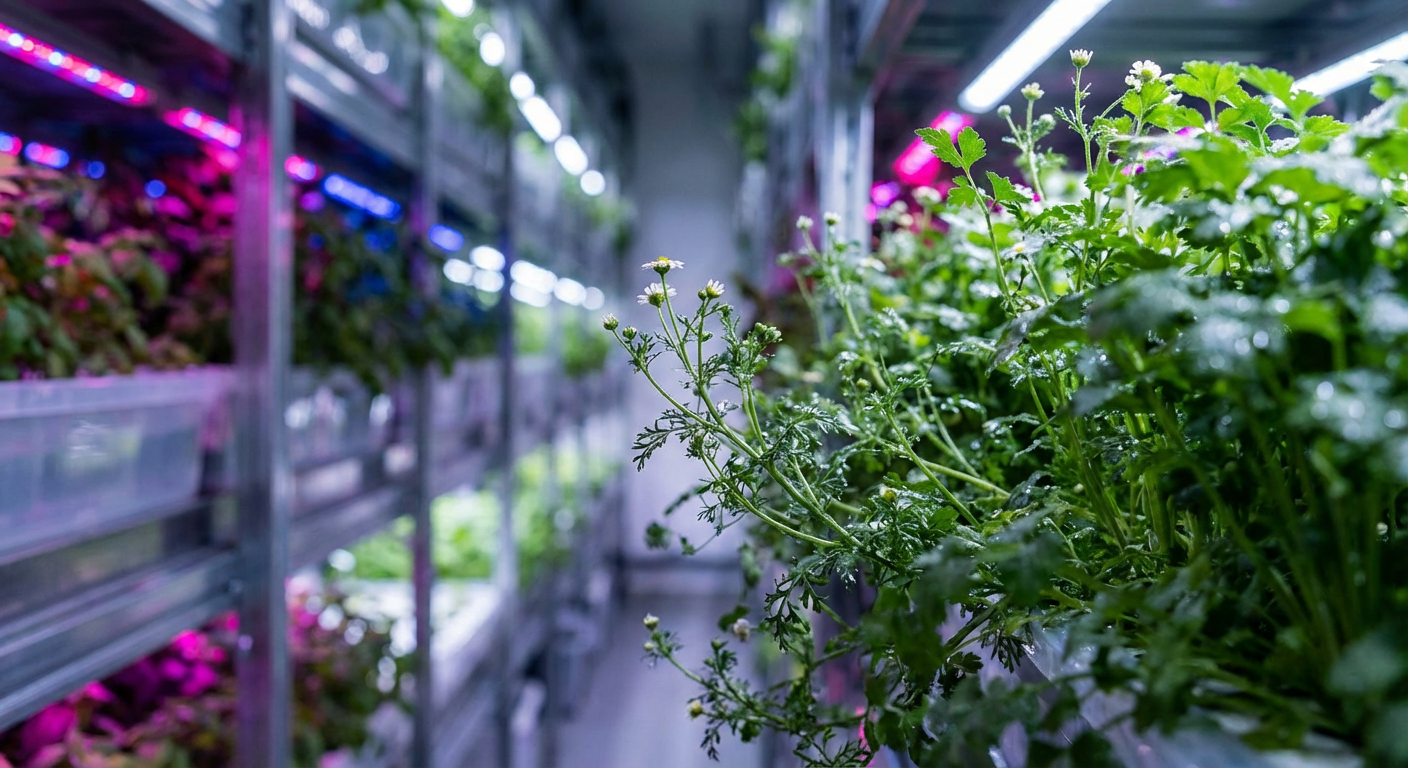
Supernormal Greens addresses the critical industry need for transparent, high-purity, and consistently potent botanical extracts through its advanced vertical farming technology. Our proprietary abiotic and biotic stress protocols, including UV-B radiation and elicitors, are engineered to trigger xenohormesis. This process intentionally upregulates secondary metabolite production, resulting in concentrations of desirable compounds far exceeding field-grown equivalents.This precise control ensures batch-to-batch consistency, a crucial factor for pharmaceutical and cosmetic manufacturing. Our zero-pesticide environment and pharma-grade microbial cleanliness meet stringent regulatory requirements. The advantages of vertical farming for specialized botanicals are well-documented, positioning Supernormal Greens at the forefront of sustainable and high-performance ingredient supply. Our life cycle assessment (LCA, Martin, 2023) demonstrates a carbon footprint of 0.72 kg CO₂-eq/kg, significantly lower than the vertical farm average (1.9 kg CO₂-eq/kg) and imported alternatives (1.4 kg CO₂-eq/kg). Furthermore, our cultivation methods are 100% EUDR-compliant by design, mitigating supply chain risks associated with deforestation regulations set to impact tropical sourcing.
Frequently Asked Questions
What are the primary differences in biological activity between rosmarinic acid and ursolic acid?
Rosmarinic acid primarily functions as a potent antioxidant and anti-inflammatory agent, efficiently scavenging free radicals and inhibiting pro-inflammatory pathways. Ursolic acid, while also possessing antioxidant and anti-inflammatory properties, is distinguished by its direct action on skin structure, stimulating collagen synthesis and inhibiting elastase for enhanced elasticity and firmness.
Can rosmarinic acid and ursolic acid be synergistically formulated for enhanced anti-aging benefits?
Yes, combining rosmarinic acid and ursolic acid can yield synergistic anti-aging benefits. Rosmarinic acid offers immediate protection against oxidative stress and inflammation, while ursolic acid provides long-term structural support by promoting collagen and elastin integrity. This multi-target approach covers both protective and regenerative aspects of skin health.
What concentrations of rosmarinic acid and ursolic acid are effective in cosmetic applications?
Effective concentrations in cosmetic applications vary widely depending on the specific formulation, intended effect, and other active ingredients. For rosmarinic acid, concentrations as low as 0.05-0.2% can show antioxidant effects, while higher percentages (up to 1-2%) may be used for more intensive anti-inflammatory action. Ursolic acid often appears in formulations at 0.1-1% for its collagen-stimulating and elasticity-enhancing properties.
Are there any regulatory challenges or safety concerns associated with using these compounds in new products?
Both rosmarinic acid and ursolic acid, when derived from common botanical sources, are generally considered safe for cosmetic and nutraceutical applications. However, specific regulatory requirements vary by region (e.g., EU Novel Food Regulation, FDA GRAS status for some uses). Concentrated extracts or novel delivery systems may require additional safety assessments and toxicological evaluations.
How does Supernormal Greens' vertical farming ensure the purity and consistency of these extracts?
Supernormal Greens utilizes proprietary abiotic and biotic stress protocols in a controlled vertical farming environment. This technology precisely induces xenohormesis, upregulating secondary metabolite production and leading to significantly higher potency. This controlled environment also ensures pharma-grade microbial cleanliness, zero pesticide use, and batch-to-batch consistency, verified through independent analysis (e.g., CTAEX lab, 2025).
What evidence supports the skin elasticity claims for ursolic acid?
Scientific evidence supporting ursolic acid's skin elasticity claims includes in vitro and in vivo studies demonstrating its ability to stimulate collagen synthesis, inhibit collagen-degrading matrix metalloproteinases (MMPs), and suppress elastase activity. These actions collectively lead to improved skin firmness and reduced breakdown of elastic fibers, as highlighted in a 2019 study in the *Journal of Medicinal Food*.
Which specific cosmetic applications are best suited for rosmarinic acid versus ursolic acid?
Rosmarinic acid is particularly well-suited for formulas targeting environmental protection, antioxidant serums, anti-inflammatory creams for sensitive or compromised skin, and post-procedure recovery products. Eugenol can serve as a synergistic compound in such formulations due to its antimicrobial properties. Ursolic acid is ideal for anti-aging creams, firming lotions, stretch mark treatments, and products aimed at improving skin density and elasticity, often complemented by compounds like ursolic acid for skin barrier fortification.
What are the long-term market forecasts for natural anti-aging ingredients like these?
The long-term market forecasts for natural anti-aging ingredients remain robust, driven by the increasing consumer demand for clean label products, sustainable sourcing, and scientifically proven efficacy. The global cosmetic ingredients market is expected to grow significantly, with a strong emphasis on botanical actives presenting mechanisms of action for structural repair and advanced protection.
Are there any patented formulations combining these two compounds that we should be aware of?
While specific patented formulations are numerous and continuously evolving, patents often cover optimized extraction methods, novel delivery systems, or specific ratios demonstrating synergistic effects. Formulators should conduct comprehensive patent searches relevant to their specific product categories and ingredient combinations to ensure freedom to operate.
How do these compounds compare to synthetic alternatives in terms of efficacy and market acceptance?
Both rosmarinic acid and ursolic acid offer comparable, if not superior, efficacy to some synthetic alternatives, particularly in their multifaceted biological activities. Their natural origin provides a significant market advantage due to consumer preference for natural ingredients. Market acceptance is high, especially for botanicals with strong scientific backing that align with clean beauty and sustainability trends. Developing high-performance anti-aging formulations requires a nuanced understanding of active ingredient profiles. Rosmarinic acid offers critical antioxidant and anti-inflammatory defense, while ursolic acid provides structural support and elasticity enhancement. By leveraging sustainable, high-purity extracts from advanced vertical farming, formulators can capitalize on market demand for effective, traceable, and environmentally responsible solutions. Contact Supernormal Greens to request samples and specifications.
References
Tundis, R., et al. 2017. Rosmarinic Acid as a Multifunctional Molecule—A Review. Oxidative Medicine and Cellular Longevity. https://www.ncbi.nlm.nih.gov/pmc/articles/PMC5722379/
Hur, J. M., et al. 2017. Anti-inflammatory effects of rosmarinic acid in atopic dermatitis animal model. Immunopharmacology and Immunotoxicology. https://pubmed.ncbi.nlm.nih.gov/28906660/
Katiyar, P., et al. 2019. Ursolic acid protects against skin aging by inhibiting matrix metalloproteinases and promoting collagen synthesis. Journal of Medicinal Food. https://www.ncbi.nlm.nih.gov/pmc/articles/PMC6647228/
Zhang, J., et al. 2022. The Role of Ursolic Acid in Skin Health and Disease. Mediators of Inflammation. https://www.ncbi.nlm.nih.gov/pmc/articles/PMC8916327/
Al-Sanae, H. F., et al. 2020. A review of plant-derived compounds with synergistic antioxidant and anti-inflammatory properties. Oxidative Medicine and Cellular Longevity. https://www.ncbi.nlm.nih.gov/pmc/articles/PMC7016766/
Sánchez-Campillo M, Gabaldon JA, Castillo J, Benavente-García O, Del Baño MJ, Alcaraz M, et al. Rosmarinic acid, a photo-protective agent against UV and other ionizing radiations. Food Chem Toxicol. 2009;47(2):386–392. doi:10.1016/j.fct.2008.11.026
Mlala, Sithenkosi, Adebola Omowunmi Oyedeji, Mavuto Gondwe, and Opeoluwa Oyehan Oyedeji. 2019. "Ursolic Acid and Its Derivatives as Bioactive Agents" Molecules 24, no. 15: 2751. https://doi.org/10.3390/molecules24152751
Tundis, R., et al. 2017. Rosmarinic Acid as a Multifunctional Molecule—A Review. Oxidative Medicine and Cellular Longevity. https://pubmed.ncbi.nlm.nih.gov/28108151/
Malek, F., et al. 2019. Mechanisms of anti-inflammatory actions of ursolic acid. Journal of Ethnopharmacology. https://www.ncbi.nlm.nih.gov/pmc/articles/PMC6963242/
Grand View Research. 2023. Cosmetic Ingredients Market Size, Share & Trends Analysis Report.https://www.grandviewresearch.com/industry/personal-care-and-cosmetics
Bafort, F., Jijakli, M.H. (2024). Vertical Farming of Medicinal Plants. In: Priyadarshan, P.M., Jain, S.M., Penna, S., Al-Khayri, J.M. (eds) Digital Agriculture. Springer, Cham. https://doi.org/10.1007/978-3-031-43548-5_5